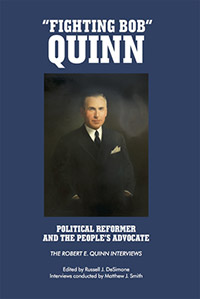
“Fighting Bob” Quinn: Political Reformer and People’s Advocate
Russell J. DeSimone, editor
Robert Emmet Quinn (1894–1975) served Rhode Island and the nation in a variety of positions. As West Warwick’s state senator to the General Assembly he helped lead the Democratic senate filibuster of 1924; as lieutenant governor he was the chief architect of the Bloodless Revolution of 1935; and as governor he called out the state militia in 1937 in what would come to be known as the Race Track War. Appointed a justice to the Rhode Island Superior Court in 1941, he served in that capacity until he was appointed the first chief judge of the newly formed United States Court of Military Appeals by President Harry S. Truman in 1951. Judge Quinn would serve on this court until just before his death in 1975. He also served as a naval officer during both world wars.
The audio interviews conducted by historian and former House Speaker Matthew Smith in 1972 and published here for the first time provide a fascinating firsthand account of Rhode Island political intrigue, election fraud and ballot stealing, ethnic politics and legislative reforms during the first half of the 20th century — topics that are still relevant today.
“During the period from 1922 through 1935 Rhode Island experienced a political transformation from the long ascendancy of the Republican Party, dating from the late 1850s, to an era of Democratic Party dominance which still endures. Reformer Robert Emmet Quinn led this Democratic drive to power, although his motives were mainly altruistic. By reading these interviews with Quinn, conducted by historian and former House Speaker Matthew Smith and edited by Russell DeSimone, those interested in Rhode Island politics can gain the insider’s view of this turbulent transformation and the many factors that produced it.”
—Dr. Patrick T. Conley, Historian Laureate of Rhode Island